
When sourcing home appliances from China, one of the first decisions a buyer needs to make is whether to work with a manufacturer through an OEM or ODM model.
The two terms are often used interchangeably, but they represent different levels of product development, customization, investment, and involvement.
For brand owners, importers, distributors, and companies entering the appliance market, choosing the right model can affect:
-
Time to market
-
Product development costs
-
Customization possibilities
-
Minimum order quantities
-
Brand differentiation
-
Long-term competitiveness
So, what is the difference between OEM and ODM, and which model is right for your appliance business?
What Is OEM in the Home Appliance Industry?
OEM stands for Original Equipment Manufacturer.
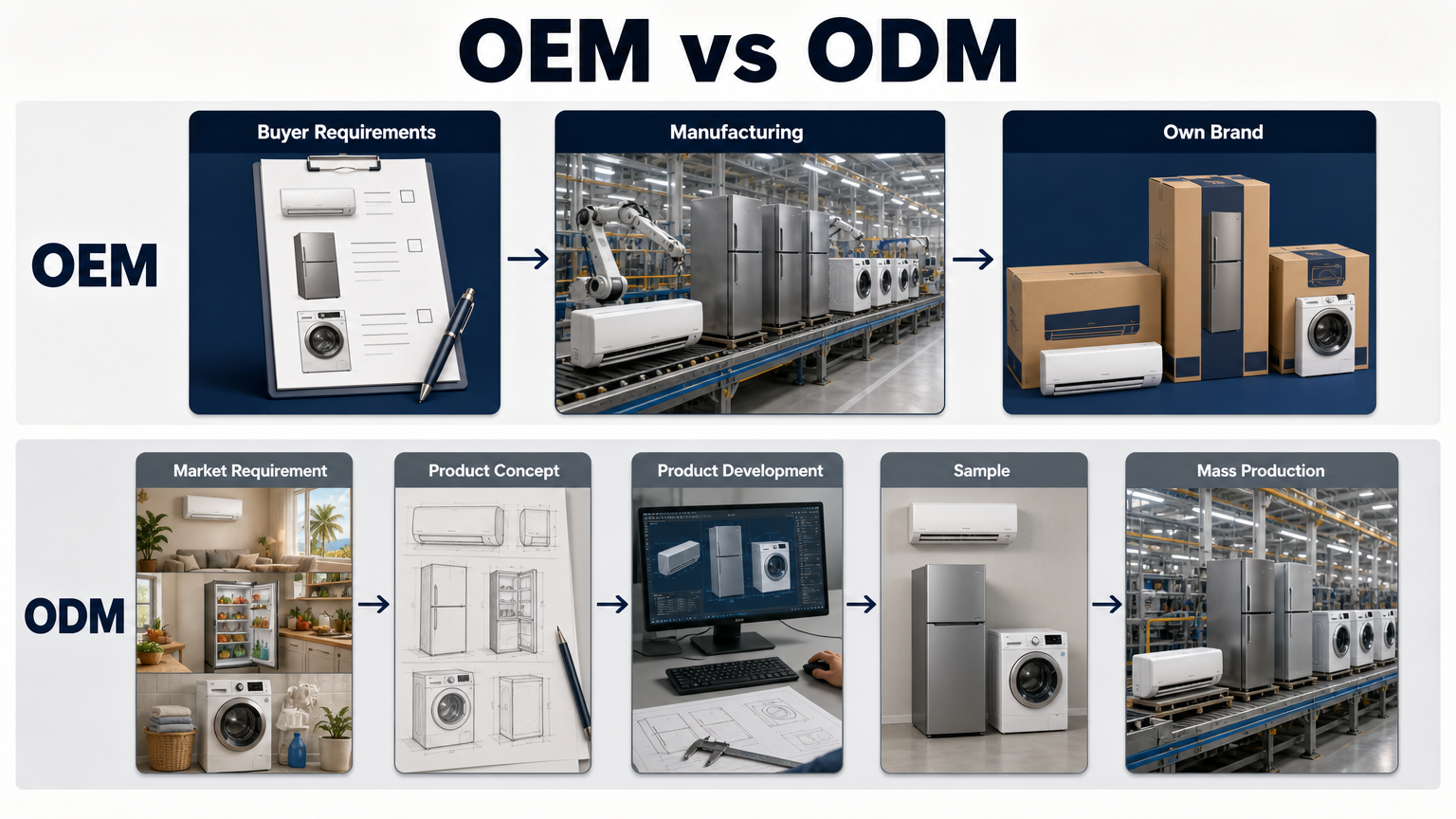
In an OEM project, a manufacturer produces products according to the buyer’s requirements, allowing the buyer to sell the finished products under their own brand.
Depending on the project, OEM customization may include:
-
Brand logo
-
Product specifications
-
Product appearance
-
Packaging design
-
Voltage and frequency
-
Plug type
-
Cooling or heating capacity
-
Product functions
-
Accessories
-
Market-specific configurations
For example, a company may want to launch an air conditioner under its own brand for a specific market.
The buyer may already know:
-
Which product category they need
-
What price range they are targeting
-
Which technical specifications are required
-
What their local market demands
-
How they want their brand to be presented
The manufacturer then supports the production and customization of the product based on those requirements.
In simple terms:
OEM allows you to build and sell products under your own brand while working with an experienced manufacturer for production.
What Is ODM?
ODM stands for Original Design Manufacturer.
In an ODM project, the manufacturer plays a greater role in product development and design.
Instead of starting with a fully defined product concept from the buyer, the manufacturer may provide:
-
Existing product platforms
-
Product design concepts
-
Technical solutions
-
Product development support
-
Engineering expertise
-
Design and manufacturing experience
The buyer can then select or adapt a product solution based on the available platform and project requirements.
Depending on the level of cooperation, the manufacturer may help develop a product from concept to production.
For example, a buyer may want to enter the portable air conditioner market but does not yet have a complete product design or engineering team.
An ODM manufacturer can help the buyer move from:
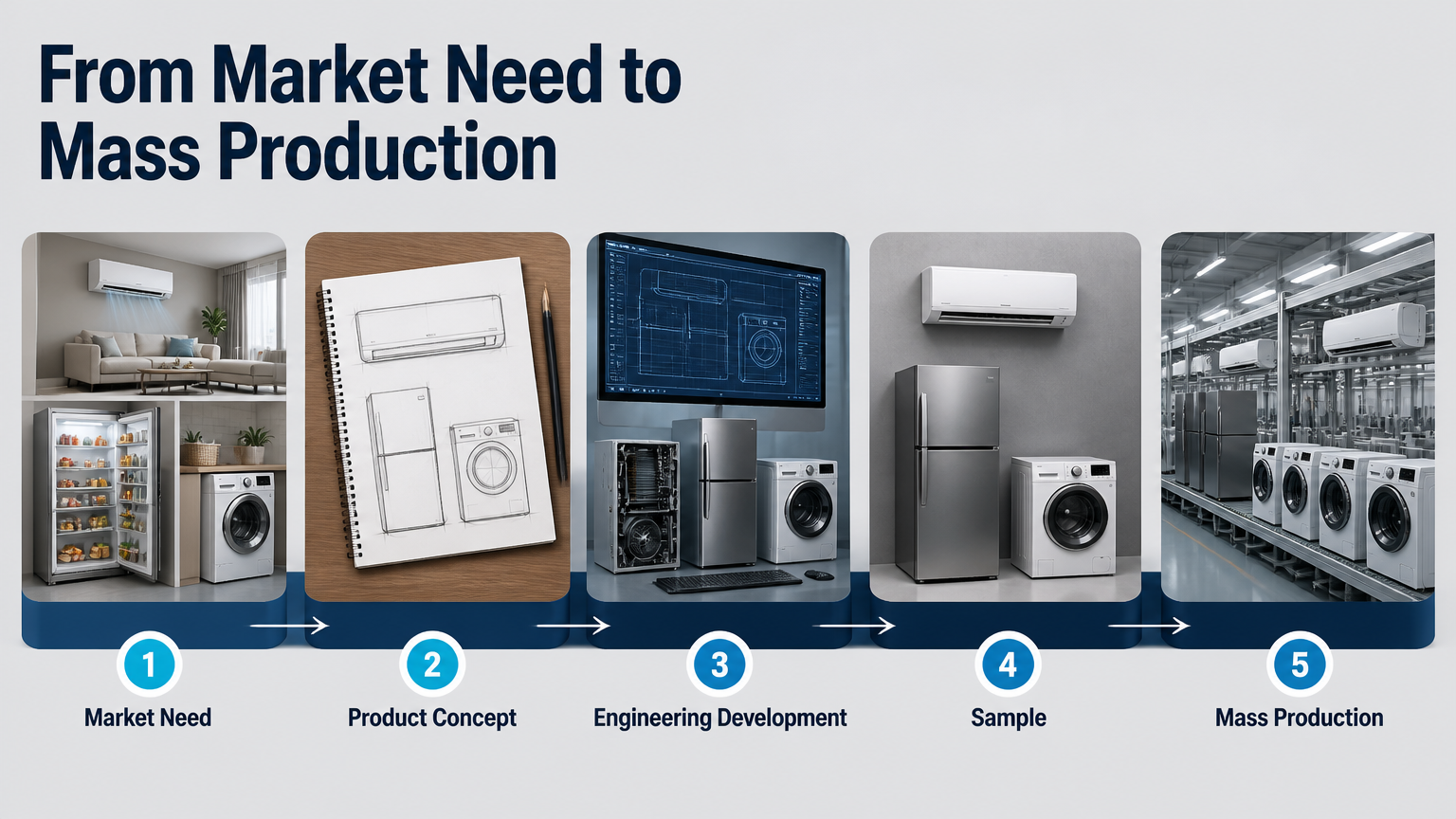
Market Requirement → Product Concept → Product Development → Sample → Mass Production
This makes ODM particularly useful for companies that want to develop differentiated products but do not have their own complete product development and engineering resources.
OEM vs ODM: What Is the Main Difference?
The biggest difference is the level of involvement in product development.
| Area | OEM | ODM |
|---|---|---|
| Product concept | Mainly defined by the buyer | Supported or developed by the manufacturer |
| Product design | Based on buyer requirements | Manufacturer provides design and development support |
| Customization | Based on project requirements | May start from an existing product platform |
| Development involvement | Buyer usually has clearer specifications | Manufacturer has greater involvement |
| Time to market | Depends on customization level | Can be faster when using an existing platform |
| Development investment | Depends on project complexity | May reduce the need for a complete internal development team |
| Brand ownership | Sold under the buyer’s brand | Sold under the buyer’s brand based on the agreed cooperation model |
 However, the distinction is not always completely black and white.
In the home appliance industry, many projects fall somewhere between traditional OEM and ODM.
A buyer may start with an existing product platform and then request changes to:
-
Appearance
-
Functions
-
Components
-
Capacity
-
Packaging
-
Branding
-
Market specifications
This type of cooperation can combine the speed of an existing product solution with a higher level of customization.
When Should You Choose OEM?
OEM may be the right choice if you already have a clear understanding of the product you want to sell.
For example, you may already know:
-
Your target market
-
Product specifications
-
Target price range
-
Product positioning
-
Brand requirements
-
Required certifications
OEM can be particularly suitable for:
1. Established Brands
If you already have an established brand and clear product requirements, OEM manufacturing allows you to expand your product range while maintaining control over your brand.
For example, a company selling refrigerators may want to add air conditioners under the same brand.
Instead of building its own factory, the company can work with an experienced manufacturer to produce suitable products.
2. Importers and Distributors
Importers and distributors often understand their local markets very well.
They may know which products sell successfully, what price range customers expect, and which specifications are required.
This market knowledge can be combined with a manufacturer’s production capability to create an OEM product suitable for the local market.
3. Buyers with Clear Product Requirements
If you already know exactly what you need, an OEM project may provide a more direct path to production.
For example:
Wall-mounted split air conditioner
Specific cooling capacity
Required voltage and frequency
Private label
Customized packaging
Market-specific configuration
In this situation, the manufacturer can focus on turning your requirements into a stable production solution.
When Should You Choose ODM?
ODM may be the better choice when you have a business opportunity but do not yet have a complete product development solution.
It can be particularly suitable for:
1. New Brands Entering the Appliance Market
Launching a new appliance brand can require significant knowledge of:
-
Product engineering
-
Component selection
-
Performance testing
-
Manufacturing
-
Certification
-
Supply chain management
An ODM partner can provide experience and technical resources that may not be available within your own company.
This allows you to focus more on:
-
Brand development
-
Marketing
-
Sales
-
Distribution
-
Customer relationships
while working with a manufacturer on product development and production.
2. Buyers Who Need Faster Product Development
Developing a completely new appliance from the beginning can require significant time and investment.
Starting with an existing product platform may allow a company to reduce development time while still adapting the product to its market requirements.
This can be useful when speed to market is important.
3. Companies Looking for Product Differentiation
If you want to offer something different from standard market products, ODM development can provide more opportunities for product improvement and customization.
Depending on the project, this may involve:
-
New product appearance
-
Functional upgrades
-
User experience improvements
-
Market-specific designs
-
Different product configurations
The goal is not simply to add a logo to an existing product.
It is to create a product solution that better fits your brand and market.
OEM vs ODM: Which One Is Faster?
In many cases, an ODM project can provide a faster starting point if the manufacturer already has a suitable product platform.
Instead of developing every part of the product from the beginning, the project may begin with an existing design and focus on the changes required for your market.
However, speed depends on the level of customization.
For example:
Simple Private Label Project
An existing product + your logo + customized packaging.
This may have a relatively short development process.
OEM Customization Project
Changes to product specifications, components, electrical configuration, or appearance may require additional development and testing.
Full ODM Development
A more customized product may require:
-
Product design
-
Engineering development
-
Prototype testing
-
Sample approval
-
Performance testing
-
Tooling
-
Production preparation
Therefore, the best model is not always the fastest model.
The right approach depends on how much differentiation your business actually needs.
OEM vs ODM: Which Requires More Investment?
The level of investment depends on the complexity of the project.
A simple private-label project using an existing product platform will usually require less development work than a completely customized product.
A project involving significant changes may require additional investment in areas such as:
-
Product development
-
Engineering
-
Tooling
-
Testing
-
Certification
-
Packaging development
For this reason, buyers should clearly discuss the project requirements with the manufacturer before moving forward.
Instead of asking only:
What is the unit price?
A better question is:
What level of customization is required to create the right product for my market?
The answer can help determine whether a simple OEM solution or a more comprehensive ODM project is the better choice.
How to Choose Between OEM and ODM
Before deciding, ask yourself the following questions.
Choose OEM If:
-
You already have a clear product concept.
-
You know the specifications you need.
-
You understand your target market.
-
You want to sell products under your own brand.
-
You need specific product configurations.
-
You want greater control over product requirements.
-
You already have experience in the appliance business.
Choose ODM If:
-
You do not yet have a complete product design.
-
You need support with product development.
-
You want to use an existing product platform as a starting point.
-
You need engineering and technical expertise.
-
You want to bring a differentiated product to market.
-
You do not have a complete internal product development team.
The Most Important Factor: Your Business Stage
For many companies, the best choice depends on where they are in their business development.
Early-Stage Brand
If you are launching a new appliance business, starting with an existing product platform and adapting it to your market may be a practical approach.
This allows you to focus on building:
-
Your brand
-
Sales channels
-
Distribution network
-
Marketing strategy
while working with an experienced manufacturer on the product side.
Growing Brand
As your business grows, you may want more product differentiation.
At this stage, deeper customization and product development may help your brand stand out from competitors.
Established Brand
Established brands may have more specific requirements and stronger internal product knowledge.
They may require a manufacturer that can support long-term OEM cooperation, customized specifications, stable production, and continuous product development.
The right manufacturing model should therefore grow with your business.
How KEYCOOL Supports OEM and ODM Appliance Projects
Choosing between OEM and ODM is not simply about selecting a label.
It is about finding the right manufacturing approach for your product, market, and business goals.
At KEYCOOL, we work with global customers on home appliance projects covering product selection, customization, sample development, production, quality control, and delivery coordination.
Depending on your project requirements, our team can support areas such as:
-
Air conditioner OEM solutions
-
Refrigerator and freezer solutions
-
Washing machine solutions
-
Product customization
-
Private labeling
-
Customized packaging
-
Sample development
-
Quality control and inspection
-
Market-specific product configurations
-
Technical and after-sales support
For customers exploring more localized manufacturing solutions, CKD and SKD cooperation may also be considered depending on the project requirements.
Whether you already have a detailed product specification or are still exploring the right solution for your market, the first step is to clearly define your business goals.
OEM vs ODM: The Right Choice for Your Business
There is no single answer that works for every company.
OEM may be the better choice if you already know exactly what product you need and want a manufacturer to produce it according to your requirements.
ODM may be more suitable if you need additional support with product development, design, or technical solutions.
The most important thing is to choose a manufacturing partner that understands both your product requirements and your target market.
Before starting a project, prepare as much information as possible about:
-
Your target country or region
-
Product category
-
Target customers
-
Expected price range
-
Estimated order quantity
-
Required specifications
-
Branding requirements
-
Customization needs
-
Long-term business plans
With this information, it becomes much easier to determine whether an OEM or ODM approach is the right fit.
Looking for an OEM or ODM Appliance Partner?
Whether you are launching a new appliance brand, expanding your product range, or developing a customized product for a specific market, the right manufacturing model can help you reduce risk and move your project forward more efficiently.
Share your product idea, target market, and business requirements with our team.
Contact KEYCOOL to discuss your OEM or ODM appliance project.
Frequently Asked Questions
What is the main difference between OEM and ODM?
OEM generally focuses on manufacturing products based on the buyer’s requirements, while ODM involves greater participation from the manufacturer in product design and development.
Can I put my own brand on OEM or ODM products?
Yes. Depending on the cooperation model and project agreement, products can be developed and supplied under the buyer’s own brand.
Is OEM cheaper than ODM?
Not always. The total cost depends on the level of customization, product development, tooling, testing, order quantity, and other project requirements.
Is ODM faster than developing a completely new product?
It can be. If the manufacturer already has a suitable product platform, the development process may be shorter than creating a completely new product from the beginning.
Can a project include both OEM and ODM elements?
Yes. Many projects start with an existing product platform and include different levels of customization based on the buyer’s requirements.
How do I know whether OEM or ODM is right for my business?
Start by evaluating your product knowledge, internal development resources, target market, customization requirements, budget, and time-to-market goals. A professional manufacturer can then help you determine the most suitable cooperation model.
Click here to see more our factory daily
Post time: Aug-21-2026